
AR Reference
Instructional Time and Attendance Accounting: https://www.cde.ca.gov/fg/it/
Attendance Recovery: https://www.cde.ca.gov/fg/it/aarecovery.asp
Guidance on Executing Attendance Recovery Programs: https://www.cde.ca.gov/fg/it/aarecoveryguide.asp
AR Tracking Requirement Summary
The following summary is advisory in nature. It is not intended to cover in detail every statutory requirement and exception, nor should it be relied upon as the authority for instructional time and attendance accounting. Refer to CDE documentation for reference.
Refer to CALPADS Update Flash #305 for more information regarding the New Data Collections for Attendance Recovery Program and Expanded Learning Programs.
Beginning in 2025-2026 fiscal year, school districts, county offices of education and classroom-based charter schools may choose to offer an Attendance Recovery program to eligible students enrolled in classroom-based programs. The AR program is an optional program for students in grades TK−12, that LEAs may provide to enable students to recoup absences for the purposes of average daily attendance (ADA) apportionment. ADA recovery is capped at the fewer of 10 days per student or the student’s total absences for the fiscal year (July 1 - June 30). An AR program may only operate outside of the regular school day (before or after school), or on weekend or intersession days (EC Section 46211(b)(1)).
In-person instruction is a condition of apportionment. AR excludes students enrolled in non-classroom-based programs, a non-classroom-based charter school, or a charter school that serves pupils pursuant to EC Section 47612.5. AR recovery excludes students continually enrolled in independent study for more than 15 schooldays (EC Section 46211(g)(1) and (2)).
The LEA must track and report attendance from participation in an AR program separately from attendance generated during the regular school day (EC Section 46211(d)(3)). The student’s participation time can be documented in daily or hourly increments, as appropriate to the duration of the AR sessions offered. A student may accrue AR participation time in hourly increments over multiple sessions or multiple days to meet the applicable minimum daily minute requirement, after which the LEA may claim average daily attendance (ADA) for the AR attendance.
A day of attendance for apportionment is generated by a student once they have participated in an AR program for the minimum daily minutes that apply to the student under EC Section 46211(e)(1).
An individual student cannot generate more than one day of attendance for any calendar day of participation in an AR program (EC Section 46211(d)(1)).
Students may “bank” AR days if participation time in AR is accrued before a student is absent. This includes attending AR programs in the summer prior to the beginning of the academic school year.
AR does not replace/modify Saturday School (the existing method to claim ADA for past absences).
Absences due to conditions that legally exclude a student from school (e.g. suspensions, lack of immunization records) cannot be made up through either AR or Saturday School.
If an absence is recovered for ADA purposes (via an Attendance Recovery program or Saturday School), the original absence record and reason need to be retained per CDE guidelines. The absence records are required by CALPADS for proper chronic absenteeism calculations and must be included in the CALPADS EOY STAS file. The original absence record and reason is also needed for SARB/Truancy reporting.
LEAs must report in the CALPADS EOY submission (STAS file) the total number of Attendance Recovery days (up to 10) for each participating student for the fiscal school year (July 1 - June 30). This data will be used to calculate an alternate chronic absenteeism rate that will be posted on DataQuest.
AR ADA attendance must be reported during the Principal Apportionment cycle, through the Principal Apportionment Data Collection (PADC). Make-up attendance generated through AR is included in the regular ADA totals at P-1, P-2, and Annual. It is also reported on a separate line for informational purposes. When reporting attendance to the PADC web app, an LEA may only claim AR ADA for absences that the student accrued in the complete months of attendance being reported.
SchoolWise AR Tracking Guide
New processes have been created for tracking AR attendance and recording when an absence has been recovered for ADA purposes. These processes can be used for an Attendance Recovery program or Saturday School.
ADA Recovery Process
ADA can be recovered via the following process:
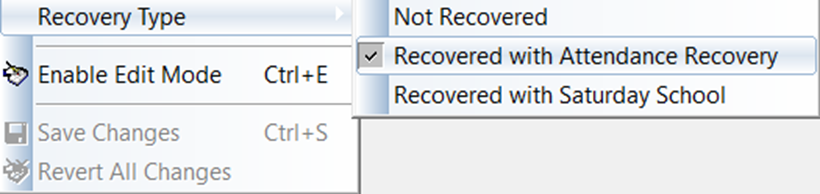
1) Open the desired ADA grade level class attendance form or the student attendance exceptions form.
2) Select the 'Absent' record for which you want to recover ADA and right-click to open the context menu.
3) Select the appropriate Recovery Type method (Attendance Recovery or Saturday School).
These Desktop ADA Calculation reports capture recovered ADA for PADC ADA reporting purposes:
• ADA Calculation - Monthly - P1 - P2 - w/AR ADA
• ADA Calculation DOR - P1 - P2 w/AR ADA
In addition to the above Monthly Attendance Reports, recovered ADA is also captured in the CALPADS STAS file export.
Setup AR Attendance Tracking
Class rosters can be setup in SchoolWise for tracking AR attendance in the Desktop Attendance form or Web Attendance form. See below for additional course setup guidance.
Since participation is optional for AR courses, use positive attendance recording (students are considered absent unless marked present). When creating a class roster for tracking AR participation time, “Positive Attendance” should be enabled in both the Course Section Defaults tab and in each course section. When taking attendance, mark students present (when present) or leave the attendance record blank (Not Taken) when absent.
Do not use negative attendance recording for AR courses. Use of negative attendance recording could result in audit compliance findings. Click here for more details regarding the Attendance Recording Method (Positive vs Negative).
Step1: Determine when AR will be offered.
If you plan on operating ELP and/or AR on non-in-session days (non-instructional days), SchoolWise can setup an alternate ELP 365 day extended calendar track so you can take attendance on in-session weekdays and non-in-session dates (holiday, intersession, weekend, etc). Please indicate the specific dates ELP and/or AR will be offered so the ELP day can be enabled in the ELP 365 day extended calendar track.
If you plan on operating ELP and/or AR only on in-session dates (before school or after school) during the academic school year, the regular academic calendar track can be used to take attendance on in-session weekdays.
Step 2: Determine how AR participation time will be tracked.
Consider the minimum AR participation time required per day of ADA (as shown below).
Grade Span | Minimum School Day | AR Participation Time Required per day of ADA |
Transitional Kindergarten & Kindergarten | 180 minutes | 3 hours |
Grades 1 – 3 | 230 minutes | 4 hours |
Grades 4 – 8 | 240 minutes | 4 hours |
Grades 9 –12 | 240 minutes | 4 hours |
Option A) Setup daily AR attendance tracking:
Daily participation tracking can be used if the AR session duration meets the minimum daily minute requirement in a calendar day. Ex. Present = 1 day of AR participation = 1 day of ADA.
Create a course for ‘Attendance Recovery Days’ using the Courses form and Courses tab (do not select the ADA Grade Levels tab). Use these Course Details: Grade Range = Not Applicable, Credits = 0, Marking System = None, Course State Code (CBEDS Code) = 6012, and set the Course Term to Full Year (if using the regular ADA calendar track) or AR Year (if using the alternate ELP 365 day extended calendar track). In the course section defaults tab, enable positive attendance and set the default minutes for the class.
Create sections as needed. Enable positive attendance and set the default minutes for each section. Set the section Schedule Term to use the regular ADA calendar track (for taking attendance on in-session weekdays only) or the alternate ELP 365 day extended calendar track (for taking attendance on any day enabled in the alternate ELP 365 day extended calendar track). Set the daily class in-session schedule (Mon-Fri is enabled by default). Use Period 9 for these course sections. Enroll students in the applicable course section(s).
Option B) Setup hourly AR attendance tracking:
Hourly participation time tracking can be used to track accumulated AR participation time in hourly increments. A student may accrue time in hourly increments over multiple sessions or multiple days to meet the applicable minimum daily minute requirement, after which the LEA may claim 1 day of AR participation. AR participation time must sum to the applicable minimum daily minutes to generate a whole day of AR ADA. AR participation time may be accumulated in hourly increments, but not in minutes or fractions of an hour. Any AR participation time documented in increments of less than one hour does not count toward meeting the required instructional time for AR. Ex. 1-59 min = 0 hours, 60-119 min = 1 hour, 120-179 min = 2 hours, 180-239 min = 3 hours, 240-299 min = 4 hours.
If fixed length AR sessions are used, the default minutes (full-hour increments) for each section can be used for tracking participation time. Ex. Present = X hours (where X = the scheduled course section duration).
If variable length AR sessions are used, the check-in/check-out time tracking function can be used to track actual participation time. Please contact SchoolWise support to enable check-in/check-out time tracking function in the SchoolWise web attendance forms (this function is not available in the desktop attendance forms). Click here for more information regarding attendance time tracking.
Create a course for ‘Attendance Recovery Hours’ using the Courses form and Courses tab (do not select the ADA Grade Levels tab). Use these Course Details: Grade Range = Not Applicable, Credits = 0, Marking System = None, Course State Code (CBEDS Code) = 6012, and set the Course Term to Full Year (if using the regular ADA calendar track) or AR Year (if using the alternate ELP 365 day extended calendar track). In the course section defaults tab, enable positive attendance and set the default minutes (full-hour increments) for the class.
Create course sections as needed. Enable positive attendance and set the default minutes (full-hour increments) for each section. Set the section Schedule Term to use the regular ADA calendar track (for taking attendance on in-session weekdays only) or the alternate ELP 365 day extended calendar track (for taking attendance on any day enabled in the alternate ELP 365 day extended calendar track). Set the daily class in-session schedule (Mon-Fri is enabled by default). Use Period 9 for these course sections. Enroll students in the applicable course section(s).
AR Reporting Considerations
• Identify which course section attendance records can be used for AR purposes.
• Compare banked AR participation time vs absent records before you can claim an AR day for ADA.
• Consider transfer students. When a student transfers within the school district, the AR participation time they accrued at one school may be applied to absences that occurred at the destination school.
AR Attendance Reports: Many attendance reports just capture present/absent records. Some reports capture time (ex. Hourly Positive Attendance). Tracking eligible accumulated hourly participation time can be challenging. The following special attendance reports have been created to only capture full hours and sum the accumulated hours for AR purposes:
These Desktop Attendance Recovery Calculation reports capture present attendance records using the defined course section minutes (scheduled session length):
Attendance Recovery Calculation Totals w/ADA Absent
Attendance Recovery Calculation w/ADA Absent
These Web Attendance Recovery Calculation reports capture present attendance records using the actual web attendance check-in/check-out time tracking data:
Attendance Recovery Calculation By Course
Attendance Recovery Calculation Whole School
Additional SchoolWise Training Resources
Click here for general information regarding course setup.
Click here for general information regarding course enrollment.
Click here for general information regarding attendance recording.